Showing posts with label school. Show all posts

Wednesday, September 7, 2011

Human Anatomy -- Blood cells

         ///I wrote this several weeks ago and thought I had posted it!! Oh well, here it is a little late :)

       It's the beginning of the semester, so it's time for our normal nerdy posts, as seen by my chemistry post yesterday. Today I shall be more informative in my post about the blood! Blood is fascinating, did you know it is considered a connective tissue? It also has many, many, small components to it, small interesting components that are vital to our survival.

         So our blood is broken down into two major components, blood cells and plasma. Most of us know we have two different types of blood cells, white blood cells (WBC) and red blood cells (RBC). The more scientific names are leukocytes and erythrocytes, respectively. We only have one type of RBC, but they are very complex cells, and they have no nucleus. They consist of several hundred million hemoglobin molecules per blood cell.

         Each hemoglobin has two alpha globins and two beta globins, in the middle of this mesh of globins is a heme group that has an iron on it, hence hemoglobin. :) RBCs make up about 45% of the components in the blood, plasma makes up about 55% and WBCs and platelet cells make up the remaining 1%.

          Now, WBCs only make up a minute part of our blood, but there are actually several different types of these cells. They are broken down into granulated and agranulated cells.
          The granulated cells are the "phils", Neutrophil, Basophil, and Eosinophils. If you hadn't guessed by their sub-type name, these cells have granules. Neutrophils stain a light violet, Eosinophils granules stain a bright red/pink, and Basophils granules stain a dark purple, and they obscure the nucleus. Their functions are as follows;

  • Neutrophils- Think of these cells as the first responders. They fight bacteria at the sites of acute infection. Meaning something that has just become infected, a scratch or a rash.
  • Eosinophils- These guys attack parasitic worms, they surround the worms and poke holes into it's body until it dies. They also produce anti-histamines.
  • Basophils- These cells are responsible for runny noses, itchy skin and all the symptoms produced by their histamine release. Histamine triggers the inflammatory response.

The agranulated cells, well, they have no granules. :) There are only two of these cells, and they are the "cytes". Both Lymphocytes and Monocytes stain purple. The Lymphocytes' nucleus obscures the cytoplasm and is usually large and round. The Monocyte has a U or horseshoe shaped nucleus with a wirey appearance, like a very thick bundle of string. Their functions are as follows;

  • Lymphocytes-These cells have two sub-types of their own, B cells and T cells. B cells make antibodies, and T cells attack virally infected cells and tumor cells.
  • Monocytes- These cells are the big guns when it comes to infection. They fight bacterial infection at the site of chronic infections. They can leave the blood stream, a process called diapedesis, they become macrophages.
The last type of cell we'll talk about in our blood, is our platelet cells. Now technically, these cells are not really cells, they are cell fragments. Megakaryocyte fragments to be exact. These cells help form blood clots.

8.23.11

8.23.11

8.23.11

8.23.11

8.23.11

Friday, September 2, 2011

EOTD: First week of school 8/22 8/23 8/25

8.22.118.22.118.22.11
8/23 Inner eye-TKB color, outer crease-Plaid is Rad VIE, edge of crease and along the bottom lash line-Sick VIE

8.22.118.22.11

8.22.11
Lookin' super cute for the first day of classes this year :).
8.22.11
8/24 Just Knife Party by Facebomb Cosmetics.
8.23.11

8.23.118.23.11


8.23.118.23.118.23.11

8/25 Just Virtual Insanity by Facebomb. :)
8.25.118.25.11


8.25.118.25.11


Thursday, August 4, 2011

Pretty, pretty pH!

So I've had this set up for awhile, not sure why I didn't post it! Just some pretty pictures of our experiment with pH and pH indicator dyes :).

6.27.11

6.27.11

6.27.11

6.27.11

6.27.11

6.27.11

6.27.11

6.27.11

6.27.11

6.27.11

6.27.11

6.27.11

6.27.11

Sunday, June 19, 2011

Experiment 40, Ten Test Tube Mystery

This experiment was harder to set up for than it was to actually do. So, we were given 10 different solutions. Of those 10, 3 were identifiable by either color or smell. So our goal was to find the other 7 through a series of tests. First we had to create a reaction table. That is, we set up a ten by ten table, and indicated the reaction between each of the 10 solutions. Which looks like this;
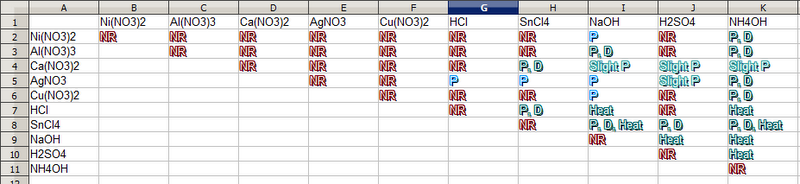


NR means No Reaction, P-Precipitate, 'P, D'- Precipitate then Dissolves, Slight P- Slight Precipitate

This was our first lab day, it took us a minute to compare each and every cation and anion to see what would happen in every reaction to identify if there would be precipitate (A solid substance formed between our two aqueous solutions), slight precipitate, or would form a precipitate and then dissolve as we added more of a solution with their ligands (something that forms a complex with the solution and basically prevents it from precipitating). We also knew that all of our bases and our acids would create heat, with no precipitate. Another identifier we were looking for was smoke, which is a reaction that occurs between HCl and NH4OH.
6.15.11
This was my groups set of chemicals. We had HCl-hydrochloric acid, H2SO4-Sulfuric Acid, SnCl4-Tin Chloride which was in a HCL solution, NaOh-Sodium Hydroxide, Ni(NO3)2-Nickel Nitrate, Al(NO3)3 Aluminum Nitrate, AgNO3- Silver Nitrate, Ca(NO3)2-Calcium Nitrate, Cu(NO3)2- Copper Nitrate , and NH4OH-Ammonium Hydroxide.
6.15.11
This was the other set, I have no idea what they are. :)
6.15.11
This was our first test. We had to determine the solutions with at least five steps. This was my thought process, but we discussed everything as a group. First, I wrote down what each of the three solutions that we knew were by direct observation. Then I wrote down what each of the solutions reacted with. The nickel nitrate and the copper nitrate only reacted with sodium hydroxide and ammonium hydroxide. We decided to test with copper nitrate. Since we also already knew the identity of ammonium hydroxide and nickel nitrate, we only needed to test the other 7 solutions. We added each unknown solution into it's own test tube, then added a little copper nitrate to each and looked for a precipitate. What was interesting is that the precipitate took all the blue out of the solution! Really cool looking. Here's my really bad paint example.

Above is supposed to be adding copper nitrate, which is blue, to 7 clear solutions. All of the samples except sodium hydroxide would just turn a diluted blue. Sodium hydroxide however would form a blue precipitate, taking all of the color out of the solution. Next we wanted to find out which were the acids. We also had the tin chloride which was in a hydrochloric solution, but we also knew that would form a slight precipitate. Hydrosulfuric acid and hydrochloric acid would just create heat with sodium hydroxide. We were also able to identify silver in this test because it creates a brown precipitate.Then to identify what which of the two solutions, that created heat when mixed, were which, we mixed them both with ammonium hydroxide. As I mentioned before, one of our identifiers was that hydrochloric acid and ammonium hydroxide would create smoke. The last two solutions we needed to identify would be aluminum nitrate and calcium nitrate, and to decide which was which, we added more sodium hydroxide to each of the unknown test tubes. Both form a precipitate with sodium hydroxide, but when enough is added to aluminum nitrate, then the precipitate disappears, where as in calcium nitrate the precipitate will be murky, but will still persist.

So there you have it! The super boring post of how to identify ten liquids by their reactions and by direct observation. :)

Friday, May 27, 2011

How hard is our water?

The last experiment I've been doing over the past week was the determination of the hardness of a water sample. The experiment was split into two days, the first was the standardization of our EDTA solution (meaning we figured out the molarity (which is moles/liter) of the solution, for those who don't know (hi mom! ^_~)), the second day was the actual testing of a water sample. We used water from a fountain on campus that I happened to have had from the previous day.

We start by titrating a 'blank' or a sample with only magnesium chloride, as we want to know the exact volume of EDTA used for it, so we can subtract it later. For a more complex explanation of the experiment you can go here.

5.23.11
Our blank with indicator. 
5.23.11
My partner getting our calcium sample ready.
5.23.11

5.23.11

5.23.11
Preparing for titration, the paper towel helps to spot the color change more easily.
5.23.11
And done!
5.23.11
First titration of our calcium sample on the left, our blank on the right for comparison.
5.23.11
Second titration.
5.23.11

5.23.11
EDTA, or the big name there on the bottle, lol.
5.23.11
The magnesium chloride sample.
5.23.11
Some hydrochloric acid.
5.23.11
Eriochrome Black T indicator, blue in distilled water, turns our samples red/pink.
5.23.11
These are volumetric pippettes that read to the hundredths spot. We used 25.00 mL ones for our standardization and then 50.00 mL ones for our actual test of a water sample.
5.25.11

5.25.11
First sample of fountain water, titrated to the end point.
5.25.11
Sample two before titration.
5.25.11

5.25.11
Endpoint titration three.
5.25.11
Materials desk, it has the magnesium sample, the indicator, and some hydrochloric acid that we didn't use.
5.25.11
These are the bulbs of the volumetric pipettes.
5.25.11
Random shot down the classroom.
5.25.11
Another students table, some very pretty colors here!